Climb Virunga Volcanoes is one of the most rewarding adventure experiences in East Africa. Stretching across Uganda, Rwanda and the Democratic Republic of Congo, the Virunga Mountain Range offers breathtaking volcanic peaks, diverse ecosystems, and unforgettable hiking opportunities.
For travelers seeking more than traditional game drives, a Virunga volcano trek adds an exciting dimension to a Uganda safari.
Many visitors combine volcano climbing with gorilla trekking in Bwindi Impenetrable National Park or Mgahinga Gorilla National Park, creating a unique safari that blends adventure, wildlife and spectacular mountain scenery.
Whether you choose to hike Mount Sabinyo, Mount Gahinga, or Mount Muhabura, each volcano offers stunning views of the surrounding landscapes and a chance to explore the remarkable biodiversity of the Virunga Conservation Area.
A Virunga volcano climb is perfect for active travelers looking to experience Uganda’s natural beauty from a different perspective while complementing their wildlife safari with an unforgettable mountain adventure.
Climb Virunga Volcanoes: The Ultimate Guide to Hiking the Virunga Mountains
The Virunga Volcanoes are among the most dramatic and rewarding hiking destinations in all of Africa. Straddling the borders of Uganda, Rwanda and the Democratic Republic of Congo, this chain of eight volcanoes rises from the equatorial forest floor to heights exceeding 4,500 metres and along their slopes live some of the world's last remaining mountain gorillas.
To climb Virunga Volcanoes is to experience Africa at its most raw and magnificent. Snow-capped peaks above the equator. Ancient lava fields. Bamboo forests so thick daylight barely penetrates. And on the crater rim of Nyiragongo, an active lava lake that glows orange against the night sky in a spectacle unlike anything else on earth.
This guide covers everything you need to know about how to climb Virunga Volcanoes — which peaks to choose, how to prepare, what it costs and how to plan your expedition from Uganda or Rwanda.
What Are the Virunga Volcanoes?
The Virunga Massif is a chain of eight volcanoes running roughly east to west along the borders of Uganda, Rwanda and the DRC. The range forms part of the Albertine Rift the western branch of the Great Rift Valley and is one of the most bio diverse regions on earth.
The eight volcanoes are:
| Volcano | Height | Country | Status |
|---|---|---|---|
| Karisimbi | 4,507m | Rwanda / DRC | Dormant |
| Mikeno | 4,437m | DRC | Dormant |
| Muhabura | 4,127m | Uganda / Rwanda | Dormant |
| Bisoke (Visoke) | 3,711m | Rwanda / DRC | Dormant |
| Sabyinyo | 3,645m | Uganda / Rwanda / DRC | Dormant |
| Gahinga | 3,474m | Uganda / Rwanda | Dormant |
| Nyiragongo | 3,470m | DRC | Active |
| Nyamuragira | 3,058m | DRC | Active |
Of these, the most accessible for hikers are Muhabura, Sabyinyo, and Gahinga from Uganda; Bisoke and Karisimbi from Rwanda; and Nyiragongo from the DRC side — though access to the latter depends heavily on the current security situation.
The volcanoes are protected within three national parks: Mgahinga Gorilla National Park (Uganda), Volcanoes National Park (Rwanda) and Virunga National Park (DRC).
Why Climb Virunga Volcanoes?
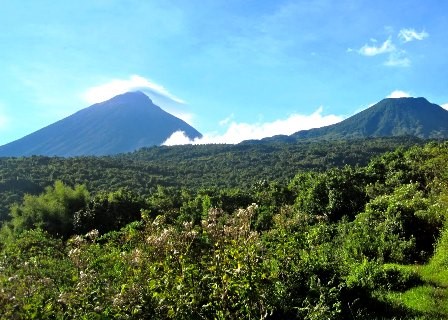
The Virunga Volcanoes offer something that very few hiking destinations in the world can match — the combination of serious mountain terrain, extraordinary wildlife, and a landscape shaped by ongoing volcanic activity.
Here is why climbers and adventurers make the journey from around the world:
- Altitude and challenge — peaks between 3,400m and 4,500m offer a genuine high-altitude trekking experience without the technical rope-and-ice-axe requirements of the Himalayas or the Andes
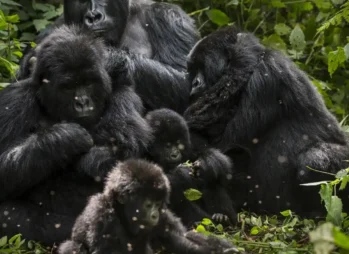
- Mountain gorillas — the Virunga range is home to roughly half of the world's remaining mountain gorilla population; combining a volcano hike with gorilla trekking is one of Africa's greatest wildlife experiences
- Crater lakes — several volcanoes have stunning crater lakes at their summits; Bisoke's crater lake is one of the most photographed natural features in Rwanda
- Rare flora and fauna — the slopes host giant lobelias, giant groundsels (Senecio), golden monkeys, forest elephants, and over 180 bird species
- Cross-border adventure — the tri-point summit of Sabyinyo, where Uganda, Rwanda, and the DRC meet, is one of the most unusual summits in Africa
- Active lava — Nyiragongo's permanently active lava lake is the largest in the world and one of the most visceral natural spectacles on the planet
The Best Virunga Volcanoes to Climb
Muhabura (4,127m) — Uganda's Highest Virunga Peak
Starting point: Mgahinga Gorilla National Park, Uganda
Difficulty: Challenging
Duration: Full day — approximately 8–10 hours return
Best season: June to September, December to February
Muhabura, meaning "the guide" in Kinyarwanda, is the highest of the three volcanoes accessible from Uganda's Mgahinga Gorilla National Park and one of the most rewarding climbs in the entire Virunga chain. On a clear day, the summit offers views across all eight volcanoes, Lake Edward, Lake Victoria, and as far as the Rwenzori Mountains.
The climb begins at the Mgahinga park headquarters and ascends through thick bamboo forest, Hagenia woodland, and open moorland before reaching the rocky upper slopes.
The final approach to the summit is steep and requires steady footing on loose scree. At the top, a small crater lake sits in a shallow depression — a quiet reward after a long ascent.
What to expect:
- Early start required (typically 06:00–07:00) to allow enough daylight for the return
- Altitude gain of approximately 1,200 metres from the trail head
- Trail can be muddy and slippery after rain — good waterproof boots are essential
- Guides and rangers accompany all climbers; porters are available and strongly recommended
- The summit can be cold and windy even in the dry season — bring warm layers
Sabyinyo (3,645m) — The Tri-Point Summit to Climb Virunga Volcanoes
Starting point: Mgahinga Gorilla National Park, Uganda
Difficulty: Challenging (involves ladders on the upper section)
Duration: Approximately 7–9 hours return
Best season: June to September, December to February
Sabyinyo — meaning "old man's teeth" in reference to its jagged, eroded crater rim — is arguably the most dramatic summit in the Ugandan Virungass. Its name describes the profile perfectly: a series of rocky pinnacles along a narrow ridge, with steep drops on either side.
The climb is technically more interesting than Muhabura. Wooden ladders assist climbers on the steeper sections of the upper ridge, and the path crosses between three peaks before reaching the true summit. From the top, you stand simultaneously in Uganda, Rwanda and the Democratic Republic of Congo one of the only points on earth where you can be in three countries at once without moving your feet.
What to expect:
- The trail passes through excellent golden monkey habitat — sightings are common on the lower slopes
- The ladder sections require a reasonable level of physical fitness and a head for heights
- The eroded crater rim means the "summit" involves several false peaks before the final one
- Views from the top encompass all three countries and on clear days extend to Lakes Edward and Kivu
Gahinga (3,474m) — The Accessible Option to Climb Virunga Volcanoes
Starting point: Mgahinga Gorilla National Park, Uganda
Difficulty: Moderate
Duration: Approximately 5–6 hours return
Best season: June to September, December to February
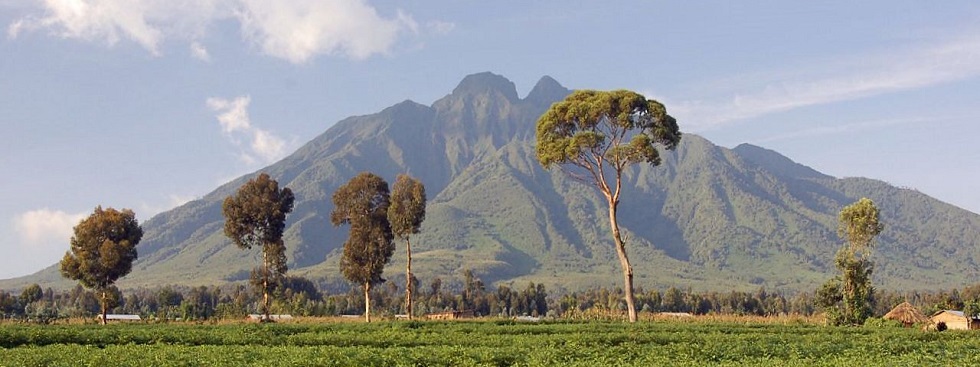
Gahinga is the smallest and most accessible of the three Ugandan Virunga peaks. It is the recommended starting point for hikers who want a serious but achievable mountain experience without committing to a full-day summit push.
The trail climbs through dense bamboo forest — excellent habitat for golden monkeys, buffalo, and forest elephants — before emerging onto open moorland dotted with giant lobelias. The summit holds a small swamp-filled crater.
Gahinga is often combined with Sabyinyo in a single long day for experienced hikers, or done as a standalone day hike for those acclimatising before attempting Muhabura.
Bisoke (3,711m) — Rwanda's Most Popular Volcano Hike
Starting point: Kinigi, Volcanoes National Park, Rwanda
Difficulty: Moderate to challenging
Duration: Approximately 6–8 hours return
Best season: June to September, December to February
Bisoke — known as Visoke in older literature — is the most popular volcano hike in Rwanda and one of the most spectacular in the entire Virunga range. The summit holds a beautiful circular crater lake roughly 700 metres in diameter, one of the most photogenic natural features in East Africa.
The hike begins at the base of the volcano in Kinigi, near the Rwanda Development Board headquarters for Volcanoes National Park. The trail climbs steadily through bamboo, Hagenia forest, and open moorland before reaching the rim of the crater. The crater lake comes into view suddenly and dramatically — a genuine reward for the effort of the climb.
What to expect:
- A ranger guide is mandatory for all volcano hikes in Rwanda
- The lower forest sections offer excellent golden monkey sightings
- The upper moorland section can be boggy — gaiters are useful
- The crater rim is exposed and cold — bring a warm layer regardless of the season
- Bisoke can also be viewed from the Rwandan side during a gorilla trekking visit to Volcanoes National Park
Karisimbi (4,507m) — The High-Altitude Challenge to Climb Virunga Volcanoes
Starting point: Kinigi, Volcanoes National Park, Rwanda
Difficulty: Strenuous (two-day expedition)
Duration: 2 days / 1 night
Best season: June to September
Karisimbi is the highest of all the Virunga Volcanoes and the fifth-highest peak in Africa. At 4,507 metres, it sits above the clouds for much of the year and the summit is often snow-dusted in the early morning. Karisimbi means "white shell" — a reference to the hailstones that regularly coat its upper slopes.
Unlike the other Virunga peaks, Karisimbi requires an overnight camp at approximately 3,700 metres — a cold, high-altitude camp that makes the full summit push possible the following morning. This is a serious mountain expedition rather than a day hike and requires good physical fitness, proper cold-weather gear, and realistic expectations about altitude.
What to expect:
- Day one: climb from Kinigi through forest and moorland to the high camp (approximately 5–6 hours)
- Night: camping at altitude; temperatures can drop below freezing; sleeping bags rated to at least -5°C essential
- Day two: pre-dawn start to the summit (approximately 3–4 hours); return to the base the same day
- The summit views on a clear morning are among the most extraordinary in Africa — the entire Virunga chain, Rwanda's Thousand Hills, and on exceptional days, the distant peaks of the Rwenzori
- Altitude sickness is a real possibility above 4,000m — acclimatise in the days before the climb
Nyiragongo (3,470m) — Africa's Most Spectacular Active Volcano
Starting point: Goma, DRC
Difficulty: Moderate (altitude and terrain; no technical climbing required)
Duration: 2 days / 1 night
Best season: When security permits — check latest advisories
Nyiragongo is in a category of its own. This active stratovolcano sits above the city of Goma in eastern DRC and contains the world's largest persistently active lava lake — a churning, glowing pool of molten rock that has been active almost continuously since 1882.
Climbing Nyiragongo and spending the night at the crater rim, watching the lava lake glow and bubble in the darkness below, is one of the most extraordinary experiences available to any traveller anywhere on earth. There is nothing else quite like it.
Important note on access: Nyiragongo sits within Virunga National Park in the DRC, and access has been subject to security restrictions at various points due to the volatile situation in eastern Congo. Before planning a Nyiragongo climb, check the current security situation and travel advisories carefully. When conditions permit, the experience is unparalleled.
How to Get to the Virunga Volcanoes
From Uganda
The gateway to the Ugandan Virunga peaks is Kisoro town, in the far south-western corner of Uganda. From Kisoro, it is approximately 14 kilometres to the Mgahinga Gorilla National Park headquarters, where all volcano hikes originate.
Getting to Kisoro from Kampala:
- By road: approximately 8–10 hours from Kampala via Kabale (420km)
- By charter flight: Kisoro Airstrip receives charter flights from Entebbe and other Ugandan airstrips; journey time approximately 1.5 hours
- Many travellers combine Mgahinga with Bwindi Impenetrable Forest for a gorilla trekking extension — the two parks are approximately 90 minutes apart by road
From Rwanda
The gateway to the Rwandan Virunga peaks is Musanze (Ruhengeri) town, a comfortable two-hour drive north of Kigali. The Rwanda Development Board headquarters for Volcanoes National Park is located at Kinigi, about 10 kilometres from Musanze. All hikes and gorilla treks in Volcanoes National Park begin here.
Permits and Costs for Climbing the Virunga Volcanoes
Uganda — Mgahinga Gorilla National Park
| Activity | Cost (per person) |
|---|---|
| Muhabura hike | USD 80 |
| Sabyinyo hike | USD 80 |
| Gahinga hike | USD 80 |
| Gorilla trekking permit (Mgahinga) | USD 800 |
| Porter fee | USD 10–15 (recommended) |
Permits for Uganda volcano hikes can be booked through the Uganda Wildlife Authority (UWA) or through a registered tour operator.
Rwanda — Volcanoes National Park
| Activity | Cost (per person) |
|---|---|
| Bisoke hike | USD 100 |
| Karisimbi hike (2 days) | USD 200 |
| Gorilla trekking permit | USD 1,500 |
| Golden monkey trekking | USD 100 |
| Porter fee | USD 10–15 (recommended) |
Rwanda volcano hike permits are booked through the Rwanda Development Board (RDB) or a registered tour operator.
What to Pack for Climbing the Virunga Volcanoes
Getting your kit right makes a significant difference on a Virunga volcano climb. The equatorial location means conditions can change quickly brilliant sunshine at the base can give way to cold mist, rain, and near-zero temperatures on the upper slopes, sometimes within the space of an hour.
Essential gear:
- Waterproof hiking boots — high-ankle, with good grip; non-negotiable on the muddy, rocky trails
- Waterproof jacket and trousers — the upper slopes are frequently wet and windy
- Warm mid-layer — a fleece or down jacket for summit temperatures
- Long-sleeved base layer — for warmth and sun protection
- Hiking trousers — quick-drying; avoid jeans
- Gaiters — strongly recommended for the boggy moorland sections
- Hiking poles — very useful on the descent; steep trails are hard on knees
- Gloves and hat — essential for Karisimbi; useful on other summits
- Headlamp — required for Karisimbi's pre-dawn summit push
- Day pack — 20–30 litres is sufficient for a day hike
- Water — carry at least 2 litres; more for longer hikes
- High-energy snacks — chocolate, nuts, energy bars
- Sun protection — sunscreen and sunglasses; UV intensity is high at altitude
- Sleeping bag rated to -5°C — for Karisimbi overnight camp only
Leave behind:
- Heavy luggage (porters carry a reasonable day pack, not full bags)
- Bright colours and strong perfume in gorilla zones
Best Time to Climb the Virunga Volcanoes
The Virunga Volcanoes can be hiked year-round, but conditions vary significantly by season.
Best months: June to September and December to February
These are the dry seasons across the Virunga region. Trails are drier, views are clearer, and the risk of altitude-amplified cold rain is lower. June to September is the most reliable window and coincides with the best period for gorilla trekking across both Uganda and Rwanda.
Avoid: March to May and October to November
The long rains (March to May) and short rains (October to November) bring heavy rainfall that makes trails extremely muddy, reduces summit visibility, and makes the experience significantly harder. That said, the volcanoes are still climbable during the rains — just less enjoyable.
Combining Volcano Hiking with Gorilla Trekking
One of the great advantages of the Virunga region is that volcano hiking and gorilla trekking can be combined in a single trip — and this combination is one of the finest wildlife and adventure experiences in Africa.
From Uganda: Mgahinga Gorilla National Park offers both gorilla trekking (USD 800 per permit) and all three Uganda volcano hikes.
Gorilla families habituated in Mgahinga are the same families that sometimes cross into Rwanda, which makes sightings slightly less guaranteed than at Bwindi — but the combined gorilla-and-volcano experience in a single park is unique.
Bwindi Impenetrable Forest, 90 minutes away, has the highest gorilla trekking success rate in Uganda and can be combined with an Mgahinga volcano day.
From Rwanda: Volcanoes National Park is the premier gorilla trekking destination in East Africa, with 12 habituated gorilla families.
The park also offers Bisoke and Karisimbi hikes, golden monkey trekking and the Dian Fossey Tomb trail — a half-day hike to the grave of the famous gorilla researcher. A three-to-four day Rwanda itinerary covering gorillas, a volcano hike, and golden monkeys is one of the most complete wildlife experiences available anywhere.
Frequently Asked Questions — Climb Virunga Volcanoes
How fit do you need to be to climb Virunga Volcanoes?
A reasonable level of physical fitness is required for all the Virunga volcano hikes. You do not need to be an athlete, but you should be comfortable walking for 6–10 hours with significant altitude gain on uneven terrain. Karisimbi demands the highest fitness level due to the altitude and overnight camp. For Gahinga and Bisoke, a good general fitness level and regular walking experience is sufficient.
Do you need climbing experience to climb Virunga Volcanoes?
No technical climbing experience or equipment is required for any of the Virunga hikes, including Karisimbi. These are hiking expeditions, not mountaineering routes. The ladders on Sabyinyo are the most technically demanding section on any of the hikes, and they are straightforward for anyone comfortable at heights.
Is it safe to Climb Virunga Volcanoes?
Uganda and Rwanda are both safe and stable countries with well-managed national parks and excellent ranger infrastructure. All climbers are accompanied by armed rangers. Nyiragongo in the DRC requires individual security assessment — check current travel advisories before planning a visit there.
Can you climb a Virunga Volcano and do gorilla trekking on the same day?
No. Gorilla trekking and volcano hikes are both full or near-full day activities. They should be planned on separate days. Most itineraries allocate at least two or three days in the Virunga region to allow for both experiences without rushing.
What is the best Virunga Volcano to climb for first-timers?
Gahinga (Uganda) or Bisoke (Rwanda) are the best options for first-time Virunga climbers. Both are achievable in a single day, involve moderate rather than strenuous effort, and offer genuinely spectacular scenery and wildlife. Bisoke's crater lake is particularly rewarding.
Can children climb Virunga Volcanoes?
The minimum age for Uganda Wildlife Authority volcano hikes is 15 years. Rwanda requires climbers to be at least 15 for Bisoke and 18 for Karisimbi. Children below the minimum age are not permitted on the trails.
How do I book to Climb Virunga Volcanoes?
Permits can be booked directly through the Uganda Wildlife Authority (Uganda) or Rwanda Development Board (Rwanda), or through a registered tour operator. Booking through a registered operator like Tulambule Uganda Safaris ensures permits, transport, accommodation, guides, and porters are all arranged in one place.
Contact our team to start planning your Virunga expedition.
Sample Virunga Volcano and Gorilla Trekking Itineraries
4-Day Uganda Virunga Experience (from Kampala)
Day 1: Kampala to Kisoro — road transfer via Kabale; afternoon at leisure in Kisoro
Day 2: Mgahinga Gorilla National Park — gorilla trekking (permit required)
Day 3: Climb Muhabura or Sabyinyo — full day volcano hike with guide and porter
Day 4: Return to Kampala or connect to Bwindi Impenetrable Forest
5-Day Rwanda Virunga Experience (from Kigali) to Climb Virunga Volcanoes
Day 1: Kigali city tour; afternoon transfer to Musanze (Ruhengeri)
Day 2: Volcanoes National Park — gorilla trekking
Day 3: Bisoke volcano hike; afternoon golden monkey trekking
Day 4: Karisimbi day one — ascent to high camp
Day 5: Karisimbi summit push; descent; return to Kigali
7-Day Uganda and Rwanda Combined to Climb Virunga Volcanoes
Day 1: Fly into Entebbe; transfer to Bwindi Impenetrable Forest
Day 2: Gorilla trekking, Bwindi
Day 3: Transfer to Mgahinga Gorilla National Park
Day 4: Climb Sabyinyo or Muhabura from Mgahinga
Day 5: Cross into Rwanda; transfer to Musanze
Day 6: Gorilla trekking or Bisoke volcano hike, Volcanoes National Park
Day 7: Return to Kigali; depart
Planning to climb the Virunga Volcanoes?
At Tulambule Uganda Safaris, we organise complete Virunga hiking and gorilla trekking expeditions from Uganda and Rwanda — including permits, transport, accommodation, guides and porters.
Get in touch with our team and let us plan your Virunga adventure.
Affordable 3-Day Gorilla Trekking Uganda Safari tour
3 Days Fly-In Gorilla Safari Uganda
3 Day Queen Elizabeth National Park Safari In Uganda
4-Day fly-in Uganda Safari – Gorillas and Chimpanzees
Best Tanzania Safaris and Tours: Explore Africa’s Top Wildlife Adventures 2026/2027